

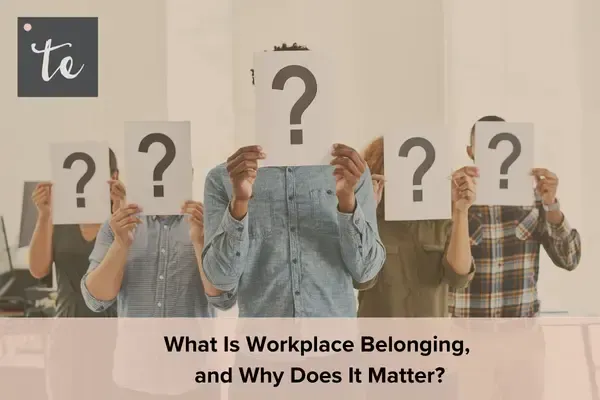
What Is Workplace Belonging and Why Does It Matter?
There's a question that more leaders are starting to ask in day-to-day operations and team management: What is workplace belonging, really, and why should it matter to me?
The answer is both simpler and more profound than many expect.
Belonging in the workplace is the feeling that you are genuinely included, valued and accepted for who you are. It's what happens when people bring their full selves to work without fear of judgment or exclusion. And while it may sound like a soft concept, the data tells a very different story.
According to BetterUp research, workplace belonging leads to a 56% increase in job performance, a 50% reduction in turnover risk and a 75% decrease in employee sick days. And research from McLean and Company found that employees who feel comfortable being themselves at work are 5.7 times more likely to be engaged and 70% more likely to stay with their organization.
These are important business outcomes.
What Is Belonging in the Workplace, Really?
When people talk about what belonging in the workplace is, they're often describing something they can feel but struggle to define. You walk into a meeting and immediately feel like your voice matters. You make a mistake and you're met with support instead of shame. You share an idea and someone builds on it rather than dismissing it.
Workplace belonging happens at the intersection of three fundamental human needs:
Feeling seen
Feeling heard
Feeling connected
When those three things are consistently present, people stop merely performing their jobs and start genuinely investing in the work and in the people around them.
The opposite is equally telling. When belonging is absent, employees become disengaged, disconnected and eventually gone. According to a 2023 LifeSpeak study, employees with low belonging scores are 59% more likely to consider quitting their job due to mental health concerns. That's a leadership and culture issue with direct business consequences.
Why Is Belonging Important?
Because people don't leave jobs, they leave environments where they don't feel valued.
According to Gallup's most recent employee engagement data, only 39% of employees feel strongly that someone at work cares about them as a person, down from 47% in March 2020. Which raises the harder question. What does that say about the other half? If someone can't say with certainty that anyone at work cares about them, they don't feel like they belong. And that gap is growing.
As we explore in our work on reducing employee turnover, this kind of attrition rarely looks like a crisis. Employees don't usually announce that they feel unseen. They simply become less responsive, less creative and eventually less present. By the time the seat is empty, the relationship has been eroding for months.
That's why belonging is important. Because it is one of the most protective forces available to an organization.
A Culture of Belonging in the Workplace: What It Looks Like in Practice
A culture of belonging in the workplace is a pattern of behavior that gets reinforced (or undermined) every single day.
It shows up in who gets invited to weigh in on decisions. When leaders actively seek input from people across levels and backgrounds, they signal that every perspective has value. When they don't, the message is equally clear.
It shows up in how recognition is handled. Generic, blanket praise can feel hollow. Specific, personal acknowledgment, something that says, "I see what you contributed and it mattered," lands entirely differently.
It shows up in the in-between moments. The check-in when nothing is urgent. The note that acknowledges a personal milestone. The small gesture that says "you matter beyond what you produce for this organization." This is the same principle we often discuss in the context of client relationships. People notice when they're valued consistently, not just when it's convenient.
Examples of Belonging in the Workplace
Sometimes the most useful thing is to make the abstract concrete. Here are 3 examples of belonging in the workplace that go beyond policy and show up in everyday interactions:
A new hire joins a remote team. Rather than a standard onboarding checklist, a manager takes time to introduce them individually to each team member and follows up a week later to ask how they're settling in. The new hire feels noticed.
A senior team member shares a perspective in a meeting that challenges the group's direction. Instead of being redirected or talked over, they're thanked for the honesty and the idea is genuinely considered. They leave the meeting feeling like their voice carries weight.
A team finishes a difficult quarter. Instead of a generic "great job" email, each person receives a short, personalized message that names specifically what they contributed and why it mattered. They feel seen.
None of these moments required a budget line or a new initiative. They required intention.
How to Create a Sense of Belonging at Work
Understanding how to create a sense of belonging at work starts with recognizing that it's a practice. Here are the core principles that drive it:
Consistency over grand gestures: A single recognition moment is meaningful. A consistent pattern of acknowledgment is transformative. The goal is to build a rhythm of connection that people can rely on. In wins or crises as well as during the quieter stretches in between.
Personalization over uniformity: People feel belonging when someone takes the time to understand what matters to them specifically and responds accordingly. This doesn't require constant effort, but attention.
Psychological safety as a foundation: A culture of belonging in the workplace cannot exist without an environment where people feel safe to speak, ask, disagree and make mistakes. When psychological safety is absent, belonging is impossible.
Leadership that models the behavior: Belonging starts at the top. When leaders are visible in their care, when they acknowledge people personally, invite honest conversation and demonstrate that they value the human being behind the job title, that behavior ripples through the entire team.
Reflect and Rebuild: 5 Questions to Consider
As you think about the role workplace belonging plays in your organization, these questions can help you identify where you are and where there's room to grow:
When was the last time someone on your team received recognition that was specific to them personally, something that acknowledged who they are and what they uniquely contribute?
Do you have a consistent system for meaningful touchpoints with your team, or does connection mostly happen reactively, during onboarding, performance reviews or crises?
How would your team members describe the level of psychological safety in your organization? Would they say they feel comfortable sharing honest feedback, raising concerns or making mistakes without fear?
Are there people on your team who might be disengaging right now, present in body but no longer fully invested? What signals are you seeing and what would it take to reconnect with them?
Does the way you recognize and engage your team reflect what actually matters to them, or does it reflect what's easiest or most efficient for the organization?
When people feel a genuine sense of belonging in the workplace, they perform better, stay longer and show up more fully. Organizations that invest in building that culture see it in retention, in innovation and in the long-term health of the business. This work is about being more intentional with what's already there.
At The Expressory, we specialize in helping organizations build cultures of belonging through consistent, meaningful engagement with the people who matter most. Schedule a conversation or join one of our upcoming Q&A sessions to learn more.
FAQs – Frequently Asked Questions
What is belonging, and how is it different from inclusion?
Belonging and inclusion are related but distinct. Inclusion is about being invited to participate, having a seat at the table. Belonging in the workplace goes deeper. It's the feeling that your presence is genuinely valued, that you can be yourself without masking or managing how you show up and that the people around you actually want you there. Inclusion can be structural. Belonging is experiential. One is something an organization grants. The other is something a person feels.
How do you measure belonging in the workplace?
While belonging has a subjective quality, it can be assessed in meaningful ways. Regular pulse surveys that ask employees how seen, heard and valued they feel are a strong starting point. Beyond surveys, leaders can look at proxies: retention rates, participation in optional company activities, the quality of feedback in open channels and whether people are willing to raise concerns or ideas. The absence of those signals is often just as informative as the data itself.
Can you build a culture of belonging in the workplace in a remote or hybrid environment?
Yes, but in remote and hybrid settings, the informal moments that naturally build connection in an in-person environment simply don't happen on their own. Leaders need to replace them with deliberate touchpoints: personalized check-ins, recognition that names specific contributions and communication that makes people feel like individuals rather than participants in a workflow. The same principles apply (consistency, personalization and psychological safety); they just need to be more actively engineered.