
Reusing Marketing Materials To Create Meaningful Client Touchpoints
In a recent post, we explored The Growth Trap of Waiting and how the absence of a clear “reason” to reach out can quietly create distance in relationships over time. The key shift was recognizing that relevance already exists in your day-to-day work. You do not need a major event or a brand-new idea to show up thoughtfully for your clients or even your prospects.
This naturally leads to the next question many advisors and business owners ask:
“If I don’t need something new … what should I be using?”
The answer is often simpler than expected.
You already have more than enough.
The opportunity is in the reuse.
Seeing Your Work Through a Different Lens
Most firms are sitting on a wealth of thoughtful, well-developed materials. Over time, you have created presentations, guides, emails, research, checklists, blog posts and internal documents designed to explain, support and educate.
The challenge is that these materials are often viewed as one-time uses. They were created for a specific moment, delivered once and then set aside.
When you shift your perspective, these same materials become something much more valuable. They become relationship assets. A way to protect the relationships you’ve already created or are looking to nurture.
A retirement checklist is no longer just a document used during onboarding. It becomes a timely resource when a client starts thinking about what comes next. A piece of market commentary is no longer just an update. It becomes reassurance during moments of uncertainty. A research report is no longer just thought leadership. It becomes an ongoing tool that helps clients stay informed and confident. And the additional benefit is that every one of these examples is an additional opportunity to show people how much you care and want to support what’s important to them.
The value is in when the resource is shared and how it’s positioned.
Reuse as a Form of Care
There is a common hesitation around reuse that sounds something like this:
“I don’t want to send the same thing twice.”
“They’ve probably already seen this.”
“I should come up with something new.”
Those thoughts make sense on the surface, but they are rooted in a content mindset rather than a relationship mindset.
In relationships, what matters is relevance and care. And ultimately, the importance of client retention becomes clear through these small, thoughtful moments.
When you share something at the moment it becomes useful, it feels thoughtful, regardless of when it was originally created. In fact, many clients do not remember every resource they have received. What they do remember is how supported they felt when something arrived at exactly the right time.
Reuse, when done with intention, is reinforcement.
It communicates, “I’m paying attention,” and “I thought of you.”
What This Looks Like in Practice
This approach becomes much clearer when you see how it shows up in real relationships.
One financial advisor we work with writes a letter to the children of his clients when they turn eighteen and approach graduation. Along with the letter, he includes a curated set of materials that outline the financial decisions and responsibilities that come with adulthood. These are not newly created each year. They are resources he has developed over time and refined through experience.
What makes the gesture meaningful is the timing and the intention behind it. It acknowledges a milestone, supports the next generation and strengthens the relationship with the entire family. It’s a true example of thoughtful client retention techniques in action.
Another example comes from an agency owner who conducts annual market research for her industry. Rather than treating the research as a single report, she provides her clients and prospects with a physical binder. Each year, she mails the latest research along with her insights and practical worksheets to add to it.
Over time, this becomes a living resource her clients rely on. Apart from the importance of client retention, it also reinforces her role as a trusted guide who consistently brings clarity and perspective to their evolving challenges.
In both cases, the materials create emotional equity because the recipient feels seen and supported with helpful resources.
A Practical Way to Identify What You Can Reuse
If you are wondering where to begin, a helpful exercise is to step outside of your own content for a moment and look at the world your clients are navigating.
Start by identifying the key goals and priorities within the industry you serve for the coming year. For example, you might look at “2026 goals” or “top priorities” within that space. This gives you a clear picture of what your clients are likely thinking about, planning for or trying to solve.
Make a list of the themes you find in your research.
Next, come back to your own materials and ask a simple question:
Do we already have anything that could help with this?
You may find that you have more alignment than you expected. A guide that supports one of those goals. A past presentation that addresses a common challenge. A checklist that simplifies a complex process. A piece of research that provides helpful context.
Once you begin mapping your existing materials to these real-world priorities, your content becomes far more usable.
From there, consider how you might share these resources over time. This does not need to be complicated. In fact, consistency matters more than complexity.
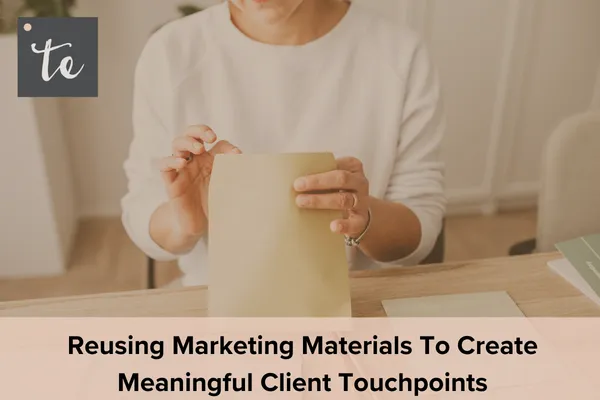
One approach is to select one of these aligned resources each quarter and send them to clients or prospects with a simple note explaining why you thought of them. In some cases, this may be an email, but we really lean on the side of direct mail. In today’s market, physical material stands out and actually connects with the part of the brain that perceives value. A printed version mailed with a handwritten message is going to feel more personal and memorable.
The goal is to demonstrate awareness and care while creating a stronger advisory practice over time.
Building a Rhythm of Thoughtful Presence
When reuse becomes part of your approach, something begins to shift.
You are no longer waiting for the “right moment” to reach out. You are creating small, meaningful moments of connection on an ongoing basis.
This creates a rhythm of presence that feels natural rather than forced.
Your clients begin to experience you not just as someone they meet with periodically, but as someone who is consistently engaged in helping them navigate what matters. Over time, this reinforces trust, strengthens loyalty and keeps the relationship active in a way that feels supportive rather than transactional.
It also reduces the pressure to constantly create something new. Instead of asking, “What should I make next?” you begin asking, “What do I already have that could help someone right now?”
That is a much more sustainable and effective place to operate from.
How to Stay Top of Mind With Clients
You do not need to reinvent the wheel to stay meaningfully connected to your clients.
You already have the tools.
The opportunity is to use them with intention, aligning what you have created with what your clients are experiencing, and delivering it in a way that feels personal and timely.
When you do, even the simplest resource can become a powerful expression of care.
Five Questions to Reflect On
Where might I be overlooking valuable materials that could be reused to support my clients?
Have I taken the time to understand the current goals and priorities of the industry I serve?
Can I clearly connect my existing resources to those real-world needs?
Am I creating a consistent rhythm of sharing, or am I still waiting for the “right” moment?
What is one resource I could thoughtfully share this week to show I am paying attention?
Frequently Asked Questions
1. How often should I reach out to clients with "reused" content?
Consistency is more important than frequency. A quarterly "Value-Add" touchpoint, where you share a relevant checklist or research piece, is a sustainable rhythm that supports strong client engagement strategies and helps you stay top of mind with clients without overwhelming them.
2. Will clients be annoyed if I send them something they’ve seen before?
Rarely. Most clients don't remember every document you've sent, but they do remember the timing. If you send a "Retirement Checklist" exactly when they mention a life transition, it feels like a concierge service, not a repeat resource. This is a simple but effective example of client retention techniques and reinforces the importance of client retention in long-term relationships.
3. What are the best types of content to repurpose for client engagement?
The best materials are "evergreen" assets: checklists, "how-to" guides, simplified market philosophy summaries and onboarding documents. These act as valuable relationship assets that continue to deliver relevance over time and can easily be incorporated into direct mail or digital outreach. The reality is, anything is the right type of content if it applies to the moment you are acknowledging.
4. How can I make reused content feel personal?
The "magic" is in the delivery. Instead of a mass blast, include a short, handwritten note or a personalized two-sentence email explaining why you are sending this specific piece to them right now. This approach aligns naturally with strong advisory practice management and answers the underlying question of why client retention is important. Because thoughtful, personal moments are what clients remember.