
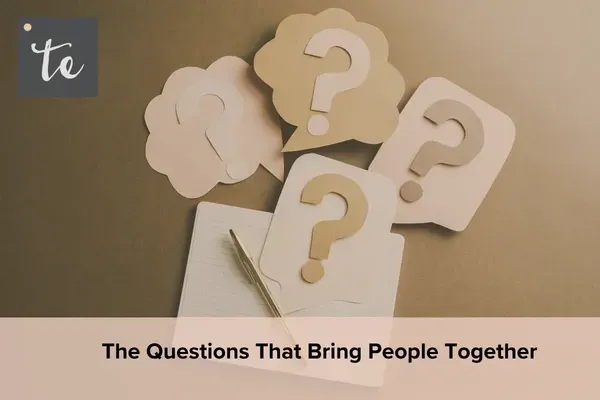
The Questions That Bring People Together
“Wait … what am I supposed to talk about?”
It’s the question that rarely gets asked out loud, but you can feel it the moment you walk into a networking event. There’s that brief pause at the entrance, the subtle scan of the room and the internal calculation of where to go and how to begin.
A lot of the people we interact with at business events are having an internal battle to stay present, they just don’t talk about it. Introverts frequently share with me that they don’t always know how to make small talk at a networking event because it feels’s uncomfortable to have conversations with strangers. The reality is that it doesn’t feel natural for most people. And then we add the complication of technology causing a large portion of the population to freeze if the conversation isn’t happening through text.
I was reminded of this again at this year’s BABA Summit (Build a Better Agency), where I’ve spent the last five years watching something fascinating unfold. But the reason I notice it now is because of a moment that happened several years ago, and it shaped how I approach every event and every conversation since.
The Moment That Changed Everything
About four years ago at this same event, I sat down next to someone who has since become one of my favorite humans. In the middle of a casual conversation, he shared something about himself that could have easily been brushed past.
He said, “You may not know this about me, but I’m neurodivergent.” And then, almost as an afterthought, he added that he can be a little … weird.
There was something about the way he said it that was so refreshing. It wasn’t apologetic at all. It was simply a truth he had come to understand about himself. What he didn’t know is that two other people had shared with me, that very same day, that they were neurodivergent as well, and that impacted how they show up at events.
So, instead of moving on, we leaned into it. I told him that being weird sounds like something we could all say.
We turned to the table and asked, “What’s something that makes you weird?” And we had every single person at the table respond. Trust me when I say it was not forced. It was an absolute blast.
What followed was one of the most engaging, memorable networking conversations I’ve experienced at any event. People shared stories that you would never hear in a typical networking exchange or from a traditional conversation starter. We didn’t bother to define weird, we left it open to interpretation and whatever people wanted to share. I admitted that I can say the alphabet backwards, which feels so unimpressive compared to what everyone else revealed. Someone told a story about meeting June Carter Cash as a child, and you could feel the entire table leaning in. Another person had met the Pope. A couple of the men at the table admitted, with complete sincerity, that they love Hallmark movies, especially the Christmas ones. And of course, there were some truths we promised to keep at the table!
The conversation worked because it created permission. Permission to show up as something other than polished and professional. Permission to share something personal without it needing to be perfect or impressive. Permission to simply be human in a room where most people feel like they need to perform and put on a smile.
Questions that bring people together have now become a bit of a tradition at our dinners. A core group always findsfind each other because we come prepared for the next question. The conversations deepen quickly, people relax and the room shifts in a way that feels noticeably different.
That moment is what made me start paying attention and change the way I was showing up.
Watching It Play Out in Real Time
Fast forward to this year’s event, and I found myself in two different breakfast conversations that reinforced just how powerful these moments can be when you create space for them. I now show up with unique questions and conversation starters for networking ready to go when the moment presents itself.
The first morning, the conversation at the table reached that familiar lull. It’s the point where the standard questions to ask at a networking event have been asked and answered, and no one is quite sure where to take things next.
I pulled out one of my conversation starter cards, something I now carry with me intentionally, and asked, “Where is the most unlikely place you’ve ever made a friend?”
It was not an easy question, and that turned out to be what made the conversation entertaining. People paused. They asked for clarification. They debated what qualifies as a “friend.” Does it count if you never exchanged numbers? Does it count if it was just a moment in time?
As they worked through the question together, the conversation became collaborative. It also revealed the difference in how people experience social interaction.
One woman, who is genuinely one of the kindest people you could meet, shared that she does not go to events looking to make friends. She explained it with the sweetest smile and a level of honesty that immediately resonated with others at the table, “I don’t like making friends”. It takes effort for her to stay engaged in conversation, and that effort is something she manages intentionally.
Next to her was Susan Baier, from Audience Audit, who is wonderfully extroverted. She responded to that honesty with her own experience in a completely different way. She told us, in her humorous way, that she often feels a sense of competition when she meets someone interesting. She might admire something about them and immediately wonder why she doesn’t have it or how she could do it better.
The contrast was both entertaining and insightful. People began to see themselves in one perspective or the other, and the conversation naturally expanded because of it. This is exactly what the best questions to ask at a networking event do. They create a shared experience rather than a performance.
The Table Everyone Wanted to Join
The next morning, I walked into the room and immediately noticed Baier sitting with Phillip Ramsey of Uncommon Wealth. I knew that was my table, full of my people.
Ramsey had already started the conversation by the time I arrived, and his question was, “We’re forming a band. What would you play?”
What made this question so effective as a conversation starter for networking wasnetworking I' was how easy it was to enter. There was no right answer, no expectation and no pressure to be impressive. People simply chose a role.
Within minutes, we had uncovered a range of hidden talents. One person was a classically trained pianist who spoke about his instrument with a level of care that made it clear that it was a meaningful part of his life. Someone else played the harpsichord. I claimed the tambourine, without hesitation, because a flute wouldn’t work in the band! There was a French horn player, a guitarist and a bass player who shared stories from being in an actual band. He even shared his band business card! Now, that’s something you can talk about.
And this is the part where you start assuming that only the extroverts were sitting at our table. Not true! The quieter people gravitated to roles that the band needed, that weren’t on stage. One woman decided she would handle lighting and tech. Another stepped into the role of promoter.
Everyone participated in a way that felt comfortable to them, and that’s what made it work. That’s an important factor to consider when you’re wondering how to break the ice at networking events. Will people be comfortable participating? You don’t need people to be vulnerable. You just need to leave room for everyone to enter in a way that feels like them.
As the conversation continued, something else started happening. People who had just walked into the room, unsure where to sit, were naturally drawn to the energy at the table. They were invited in without hesitation, and yes, even the ones who hesitated ultimately made the leap to join us. Each person found a role in the band and were immediately included in the experience.
The dynamic shifted from a group of individuals sharing a table to a group actively creating something together, even if it was entirely imaginary. That table was the loudest in the room with all the laughs and we capped off our time together with a band photo. Which btw, had great social following when shared by the drummer!
Why These Questions Work
What I’ve come to understand is that the effectiveness of these conversations has everything to do with the type of question being asked.
Questions that build connection invite stories in a way that traditional networking questions do not.tend to open people up in ways that traditional networking questions do not. They allow for interpretation, which means people can engage at their own comfort level. They also create shared experiences, even among people who have just met.
In a world where much of our communication has become digital and transactional, these types of interactions are becoming less common, which is exactly why they stand out. The ability to relate to one another at a human level is something that requires more intentionality than it once did, and when it happens, people notice.
A Few Questions to Keep in Your Back Pocket
If you’re walking into an event and wondering where to start, it can be helpful to have a few networking conversation startersquestions ready that will naturally lead to more engaging conversations.
Here are a few that have consistently worked:
Where is the most unlikely place you’ve ever made a connection with someone?
If we started a band right now, what role would you play?
What’s something that makes you weird?
What would I find in the gift shop of the museum of you?
If you had to produce an event around something you enjoy, what would that event be?
If you had to stand up and give a toast, right now, what would the subject be?
Each of these questions creates just enough space for interpretation that people can answer in a way that feels natural to them, while also inviting others into the conversation.
For the Ones Who Feel “Weird” Walking In
If you’ve ever described yourself as awkward, introverted or a little weird in these settings, you’re not alone. In fact, you’re likely more aware of the dynamics in the room than you give yourself credit for.
Not many of us will ever effortlessly enter a new room. The goal is to find a way to engage that feels aligned with who you are.
Sometimes that starts with asking a better question.
For Leaders Paying Attention
If you’re leading a team, especially as newer generations enter the workforce, you may already be noticing that these types of interactions do not always come naturally.
That is not a flaw. It is a reflection of how much of our communication has shifted to digital environments, where the opportunity to practice in-person interaction has been reduced.
This creates an opportunity for leadership. You can model what meaningful conversation looks like, provide tools that make it easier to engage and create environments where people feel comfortable participating without pressure.
When people feel understood and included, relationships begin to form, and those relationships are what support trust, collaboration and long-term business growth.
A Few Questions to Ask Yourself
As you think about your own approach to networking and connection, it may be helpful to reflect on a few questions:
Am I creating space for real conversation, or am I relying on surface-level exchanges?
Do the questions I ask invite stories, or do they lead to short answers?
How comfortable do people feel participating when they interact with me?
Am I paying attention to the moments when a conversation naturally opens up?
What could I do differently to make it easier for others to feel included?
Bringing It All Together
That table at BABA was memorable because of how people were invited to participate. And they did!
The conversations were not forced, and they were not particularly structured. They simply created enough space for people to show up as themselves and contribute in a way that felt natural.
When that happens, people relax. They engage more fully. They remember the interaction long after the event is over. They might even write a blog about it!
And it all starts with a question that gives someone permission to be human. If this resonated and you want to talk about how intentional connection can strengthen the relationships that matter most to your business, schedule a conversation with us to learn more about it.
Frequently Asked Questions
What are the best networking conversation starters to use at a business event?
The best networking conversation starters are ones that invite interpretation rather than demand a specific answer. Questions like "If we started a band right now, what role would you play?" or "Where is the most unlikely place you've ever made a connection with someone?" work because they leave room for people to engage at their own comfort level. There is no right answer, no pressure to perform and no expectation of polish. That openness is exactly what makes them land.
What are good questions to ask at a networking event when the conversation stalls?
When the standard questions to ask at a networking event have been asked and answered and the conversation hits that familiar lull, that's exactly the moment to reach for something unexpected. The best questions to ask at a networking event are the ones that create a shared experience rather than a transactional exchange. "What would I find in the gift shop of the museum of you?" or "What's something that makes you weird?" are the kinds of conversation starters for networking that shift the dynamic from polished to genuinely human, quickly.
How do you break the ice at networking events if you're introverted or uncomfortable with small talk?
How to break the ice at networking events looks different for introverts than it does for natural extroverts, and that's completely fine. The goal is not to work the room effortlessly. It's to find one question that creates enough space for everyone to participate in a way that feels like them. Knowing how to make small talk at a networking event becomes much less intimidating when you arrive with a question already in your pocket, because you're no longer trying to manufacture a conversation from nothing. You're simply creating an opening and letting people walk through it in their own way.
What makes certain questions bring people together more than others?
Questions that bring people together tend to do one specific thing. They invite stories rather than short answers. Questions that build connection allow for interpretation, create shared experiences among people who have just met and give everyone at the table a reason to lean in. The difference between "What do you do?" and "What would you play if we started a band right now?" is the difference between a transaction and a memory. One gets answered and forgotten. The other gets written about long after the event is over.