
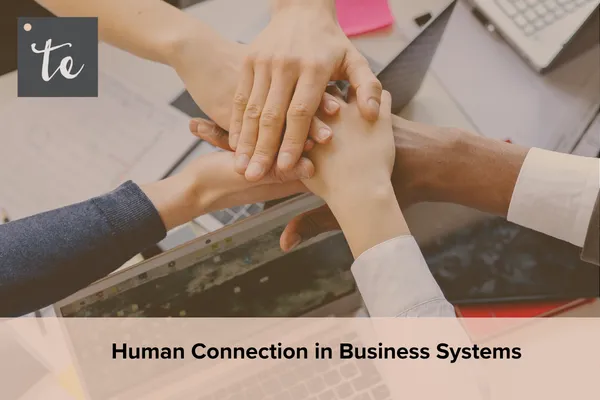
Human Connection in Business Systems
Most businesses treat workplace connection as something that either happens naturally or doesn't happen at all. A team either clicks or it doesn't. A department either collaborates well or it stays siloed. Leadership rarely asks why.
The more useful question is what's actually being built, or left to chance, in the space between people.
Human connection in business doesn't come from a mission statement or a values wall in the break room. It comes from the same thing that drives every strong relationship a company has – whether with a client, a partner or an employee – consistent, intentional attention. Businesses that treat connection as a system (not a personality trait some teams happen to have), are the ones that see it show up in retention, collaboration and performance.
Why Workplace Connection Is a Business Metric, Not a Soft Skill
Gallup's research puts a number on what disconnected teams cost the world. Low engagement drains an estimated $8.8 trillion in lost productivity globally each year, roughly 9% of global GDP. Engagement and connection aren't the same thing, but they move together. People rarely stay committed to work they do alongside colleagues who feel like strangers.
This is why human connection at work deserves the same operational seriousness as any other performance driver. It isn't an HR initiative that lives in a survey once a year. It's a leading indicator of whether people bring their full effort, or just enough to get by.
Leaders often assume connection will develop on its own if the work is interesting enough or the pay is competitive enough. It rarely does. Left alone, teams default to transactional interaction – task in, task out, minimal context exchanged in between. That default quietly caps how much people are willing to give.
Remote and hybrid work has made this easier to overlook. When most interaction happens through a screen, the informal moments that used to build connection almost by accident, a hallway conversation, a shared lunch, catching someone's tone in person, don't happen unless someone builds them in on purpose. The businesses that adapted well didn't wait for connection to reappear on its own. They redesigned for it.
The Behaviors That Build (or Break) Workplace Relationships
Workplace relationships are shaped less by big gestures than by the accumulation of small, ordinary moments. Gallup's long-running research on workplace friendship found that employees who strongly agree they have a close relationship at work are seven times more likely to be engaged in their jobs. That single relationship changes how people show up, how much they contribute in meetings and how likely they are to stay.
The behaviors that build this kind of connection are unremarkable on their own. Remembering what a colleague mentioned last week. Checking in without needing a project update as the excuse. Making space in a meeting for someone who hasn't spoken yet. None of it looks like strategy. All of it compounds into the kind of culture people don't want to leave.
The behaviors that erode it are just as ordinary. Meetings that run entirely on status updates. Communication that only flows top-down. Teams that interact exclusively through tickets, threads and handoffs, never through an actual conversation. Connection doesn't get destroyed by one bad moment. It gets starved out by the absence of small ones.
How to Improve Connection in the Workplace Without Adding to the Calendar
Leaders often hear "build connection" and picture another all-hands meeting or a mandatory team-building event. That's rarely what closes the gap. How to improve connection in the workplace comes down to a few deliberate shifts in how people already interact:
Build in unstructured time, not just status updates. A few minutes at the start of a meeting that isn't about the agenda gives people room to actually talk to each other.
Make communication two-way by design. The same principle that strengthens client communication applies internally. Teams that only receive information disengage faster than teams that are asked for it.
Recognize contributions specifically. A general "great job, team" lands differently than naming what someone actually did. This is the same thinking behind genuine workplace appreciation. Specificity is what makes people feel seen.
Give managers permission to invest time in relationships, rather than just output. If connection only happens after the real work is done, it never happens. It has to be built into how time is spent, not squeezed in around it.
None of this requires a big program. It requires effective workplace communication that treats relationship-building as part of the job, not a distraction from it.
Five Questions Every Business Leader Should Ask Now
1. Do people on my team know anything about each other beyond their job titles?
If the honest answer is "not really," collaboration is likely running on obligation instead of trust.
2. When was the last time a meeting on my calendar wasn't entirely about deliverables?
Teams that only talk about output rarely feel connected to each other, no matter how well the output turns out.
3. Would a new hire describe our team as close, or just as coordinated?
Coordination gets tasks done. Connection is what makes people want to stay and do them well.
4. Do my managers see relationship-building as part of their job, or as time taken away from it?
If it's treated as optional, it will always lose to whatever feels more urgent that day.
5. How would my team describe the last time they felt genuinely heard at work?
If no one can answer quickly, that's the clearest signal that connection needs more structure, not less.
Human Connection Is Infrastructure
Workplace connection isn't determined by who happens to get hired or which teams naturally get along. It's determined by whether leadership builds the conditions for it deliberately. Organizations that treat connection as infrastructure, something designed and maintained rather than hoped for, are the ones whose people stay longer, collaborate better and do work they're actually proud of.
At The Expressory, we specialize in helping businesses build the internal relationships that protect culture, retention and performance, using the same intentional, systematized approach we bring to client engagement.
If this resonated and you want to talk about how to create more intentional human connection as a performance driver for your business, schedule a conversation with us to learn more about it.
FAQs – Frequently Asked Questions
What does human connection in the workplace actually mean?
Human connection at work refers to the genuine, ongoing relationships employees build with each other and with leadership, beyond the transactional exchange of tasks and updates. It's built through consistent small moments, being heard, remembered and acknowledged as a person, not just a role.
How do you improve connection in the workplace without adding more meetings?
The most effective approach changes how existing time is used. Building unstructured conversation into meetings, making communication genuinely two-way and giving managers room to invest in relationships, not just output, builds connection without expanding the calendar.
Why do workplace relationships matter for retention?
Employees with strong workplace relationships are significantly more likely to stay engaged and committed to their work. When people feel connected to their colleagues, work feels less transactional and more like something worth showing up for consistently.
What role does communication play in workplace connection?
Effective workplace communication is the foundation connection is built on. Teams that only communicate through top-down updates or task handoffs rarely develop real relationships. Two-way, specific and consistent communication is what turns coworkers into a genuinely connected team.