
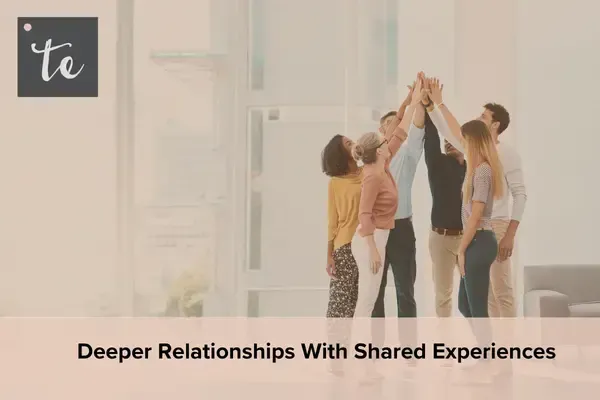
Deeper Relationships With Shared Experiences
There's a moment in most business relationships when something shifts.
It happens somewhere in between when you sign the contract and the time you host your next quarterly review. Maybe it’s during a dinner where a real conversation breaks out, after a difficult project that everyone survived together, or in a room full of people sharing something they didn't expect to find in common. In that moment, the relationship moves from professional to something harder to replace.
That's the power of shared experiences. And it's one of the most underutilized strategies available to leaders who want to build loyalty that holds.
Why Shared Experiences Work
The research behind this is grounded in more than intuition. Research shows that intentionally building social ties at work directly improves individual and team performance. The brain chemical oxytocin (released during positive social interactions like shared laughter, collaborative challenges and moments of genuine connection) shows that high-trust environments produce measurably different outcomes. Employees in those environments report significantly more energy, higher engagement and less burnout than their counterparts in low-trust settings.
When people go through something together, whether it's meaningful, funny, challenging or memorable, the brain begins to associate that other person with safety and reward. Repeated over time, those associations become the foundation of real trust. Not the kind that's assumed because a contract exists, but the kind that gets tested and holds. Shared experiences as a strategic storyline are a deliberate way to create deeper relationships with the clients, partners and team members who matter most to your business.
The Difference Between Contact and Connection
Most leaders stay in consistent contact with the people around them. Weekly check-ins, project updates and performance reviews; the calendar fills up quickly. But contact and connection are not the same thing.
How to deepen relationships at work gets answered by designing moments that allow people to show up as more than their role. A team member sitting across from you in a structured one-on-one is performing. A team member who just survived a high-stakes product launch alongside you, or who laughed until they cried at a team dinner, has given you something real. And so have you.
This distinction matters because frequency alone doesn't build loyalty. You can talk to someone every week and still have the relationship feel transactional if none of those interactions acknowledge who they actually are. Shared experiences interrupt that pattern. They create a reference point that lives outside the work itself. And those reference points are what people return to when they're deciding who they want to keep working with.
Shared Experiences Within Your Team
Sharing experiences with team members is one of the most direct investments a leader can make in retention and collaboration. And it doesn't require a retreat budget or an off-site event.
Some of the most effective moments happen in the margins of the work itself. A debrief that gets honest. A small win acknowledged specifically by name. A stretch moment where the team rallies around someone. What matters is that the moment is recognized and, where possible, memorialized with a note that references the project or a message that says, "I saw what you put into that." These are proof of attention, and that proof builds something harder to manufacture: the feeling that someone is genuinely invested in you.
Employee engagement using shared experiences is most effective when it becomes part of the culture rather than an occasional program. When leaders model this, showing up curious, acknowledging the human context around the work, team members follow that lead. Employees at high-trust companies report higher performance and meaningfully more life satisfaction. The shared emotional landscape of a team shapes how people feel about the work itself.
Shared Experiences With Clients and Partners
The same principle extends outward. The clients and referral partners who stay long-term are almost always the ones who have a story to tell about you, about a moment you shared.
A pre-event gift box that made them feel like they already belonged. A framed quote from a podcast interview you hosted together. A message that references a challenge you navigated alongside them. The format matters far less than the intention behind it. I was paying attention. I remember what we went through.
That's what separates a vendor from a partner. And that shift in identity (vendor to partner) is exactly where emotional loyalty is reinforced.
Building This Into Your Approach
Trust building with shared experiences doesn't happen by accident. It happens when leaders become deliberate about two things. Creating the moments in the first place and then doing something with them before they fade.
The most common failure is inertia. A team event happens and everyone agrees it was great, and then nothing is done to extend that energy into the relationship. A meaningful conversation with a client ends and the moment passes without acknowledgment. Weeks later, the window is closed.
A more intentional approach looks like this. Identify the moments worth referencing, assign ownership of the follow-through and make the acknowledgment specific enough that the recipient knows you were actually there. This is the same principle we apply to milestone-based touchpoints. The timing and specificity of the gesture is what gives it weight. If you want this to happen consistently, it can't live in someone's memory. It needs a system.
Five Questions to Reflect On
Before you move past this, take a few minutes to honestly consider your own approach:
When did I last create a moment (intentionally) that gave someone permission to show up as more than their professional role?
How many meaningful shared experiences from the past year have I actually acknowledged in a specific, personal way?
Do the people closest to my business (clients, team members, referral partners) have a story to tell about a moment we shared, or only about work we completed together?
Who on my team is responsible for noticing these moments and making sure they're followed through on? If no one owns it, it won't happen consistently.
Am I building trust with shared experiences into my culture, or am I hoping it will happen on its own?
If you'd like to think through how to build this into an actual strategy for your clients, partners and team, schedule a conversation with us or join an upcoming monthly Q&A to talk it through together.
Frequently Asked Questions
How do you deepen relationships at work beyond regular check-ins?
Deepening relationships at work requires creating moments where people feel seen as individuals, not just as contributors to a project or outcome. That might look like acknowledging a specific challenge someone navigated with genuine recognition, designing a team experience that creates a shared story, or following up on a meaningful moment with something specific enough to show you were actually paying attention. Frequency of contact doesn't deepen a relationship. The quality and intentionality of the moments within that contact does.
How can leaders use shared experiences to improve employee engagement?
Employee engagement using shared experiences works best when it becomes a cultural expectation, not an occasional program. Leaders who model curiosity, acknowledge people specifically and create moments that stretch and connect their teams set a standard that others follow. Intentionally building social ties at work improves both individual performance and team cohesion. The shared emotional landscape of a team directly shapes how people feel about their work and how long they stay.
What's the difference between a shared experience and a regular team-building activity?
Team-building activities can create shared experiences, but they don't automatically do so. The difference is in whether the moment is acknowledged and carried forward. An activity that everyone participates in and then forgets by the following week has little lasting effect on relational equity. A shared experience that gets referenced in a note, a gift, a conversation, a piece of recognition that names what happened, those all become a relational anchor. The moment itself matters less than what you do with it afterward.